Necklace Lengths and Necklines: Choosing the Right Drop
- Trinket File
- Buying
- 15 Oct, 2026
A necklace is bought by its length and worn by its position. The number on the listing, 18 inches or 45 cm, describes a chain laid flat. On you, the same chain curves around the neck, rests on the collarbone or chest, and gets pulled lower by whatever hangs from it. Two people can buy the same length and find it sits in quite different places.
The problem is predictable, though. Neck size, the neckline you wear most and the pendant’s weight together decide where a chain falls. Sort those out and choosing a length becomes a short list instead of a guess.
Standard lengths and where they sit
Jewelers use a fairly consistent vocabulary, though exact figures vary a little by maker and between inch and metric ranges. The table follows Jewelers of America’s chart and assumes an average adult neck. A larger neck takes up more chain, so everything sits higher; a slimmer neck lets it fall lower.
| Name | Length | Where it tends to sit |
|---|---|---|
| Collar | 12–14 in (30–35 cm) | Mid-neck, close-fitting |
| Choker | 14–16 in (35–40 cm) | At the base of the neck |
| Princess | 17–19 in (43–48 cm) | On or just below the collarbone |
| Matinee | 20–25 in (50–63 cm) | Collarbone to top of bust |
| Opera | 26–36 in (66–91 cm) | At or below the bust; long enough to double |
| Rope | 37 in+ (94 cm+) | Below the bust; usually knotted, doubled or wrapped |
Most chains and pendants are sold in the princess range, for good reason. It clears the neck, lands on a reliable landmark and works with most everyday necklines. Buying one chain with no particular outfit in mind? Start there; Jared calls 18 inches its most popular all-around length.
Pick by neckline
The working principle: a necklace should sit clearly inside a neckline or clearly outside it, never on the edge of the fabric. A pendant that lands exactly where a collar or seam starts gets pushed around, catches and looks undecided.
| Neckline | What works |
|---|---|
| Crew and high necks | A collar or choker above the neckline, or go long (matinee or opera) so it lies on the fabric as a deliberate line. A short chain just bunches. |
| V-neck | Follow the shape: a pendant long enough to sit inside the point, usually princess to matinee. A chain stopping well above the point leaves an awkward gap. |
| Scoop and round | Princess length or a short pendant inside the curve. Anything on the fabric edge fights it. |
| Square and sweetheart | Shorter, flatter pieces (collar, choker, short chain with small pendant) that sit inside the frame. |
| Off-the-shoulder and strapless | The whole collarbone shows, so choker or princess works, and a statement collar can carry the outfit. |
| Shirts and open collars | One or two buttons undone: a fine choker- or princess-length chain in the opening. Buttoned up, length doesn’t matter unless the chain goes outside. |
None of this is a strict rule. It’s how you avoid the most common irritation: a necklace you’re adjusting every few minutes because it’s sitting on a seam.
What a pendant does to length
A pendant adds height and weight. A 3/4-inch drop on an 18-inch chain ends the visual line lower than the chain does, and a heavy pendant pulls the chain into a V, lowering the center further. On a fine chain the effect is obvious; on a heavier chain it’s smaller, because the chain holds its shape.
Then there’s the bail, the loop joining pendant to chain. It must pass over the clasp and the chain’s thickest point, and be big enough that the pendant moves freely instead of hanging twisted. Our guide to chains, clasps and how fastenings fail covers how chain type affects strength and why a heavy pendant on a very fine chain is a common cause of breakage.
Measure before you buy
Online, you can’t try a length on, but a few minutes with a tape measure gets you most of the way.
- Measure a chain you already like. Lay it flat, fastened, and measure from the clasp end to the end of the ring. It’s your best reference.
- Measure your neck. Soft tape around the base. A choker should be a couple of inches longer than this to sit comfortably; shorter will pinch.
- Use string. Cut a length to the size you’re considering, hold it around your neck in a mirror and see where it falls with your usual clothes.
- Add the pendant. Hang a small similar-size weight, or just note the pendant’s height and allow for it.
- Look for an extender. Many chains include a short extension or a second jump ring partway along for a couple of inches of adjustment.
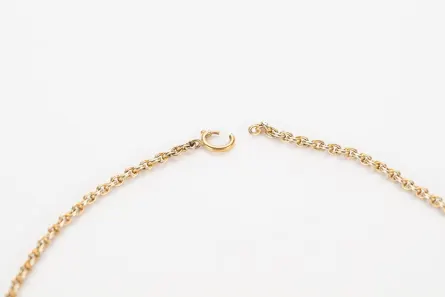
If a chain is nearly right, an extender or professional shortening usually beats replacing it. A bench jeweler can remove links from most chains and reattach the clasp, though rope or snake chain is harder to alter neatly.
Lengths for layering
Wearing more than one necklace turns one length into a sequence. Lengths need enough separation that each keeps its own line, and weight should increase toward the bottom so the lower pieces don’t ride up. A common pattern: one chain at choker length, a second at princess, a third, often with a pendant, at matinee, roughly 16, 18 and 20–22 inches. Our guide to layered gold jewelry covers spacing, texture and tangling, and the same principles hold for silver.
Pearl strands use the same vocabulary. Princess is the classic single row, while matinee and opera strands can be doubled or knotted. The modern pearl styling guide looks at how those lengths are worn now.
Quick answers
Which length works with the most outfits? For most people, around 18 inches (45 cm). It sits on or just below the collarbone and suits the widest range of necklines.
Will a choker be comfortable? Measure the base of your neck and choose a choker a couple of inches longer. One that fits closely in the morning can feel tight later, especially in warm weather.
Different length for a larger frame? A larger neck uses more chain, so a given length sits higher. Size up or choose a chain with an extender, and check the position with string first.
Can a long chain be shortened? Usually. Most cable, curb and trace chains can be shortened and the clasp reattached. Rope, snake and box chains are trickier and may show the join.