Layered Gold Jewelry: Building a Stack That Works
- Trinket File
- Buying
- 28 Sep, 2026
Layered gold looks easy when it’s edited. It looks heavy when every layer fights for the same space. The difference is rarely how much gold you’re wearing. It’s order, scale and movement, plus a few practical details that keep a stack comfortable all day.
It looks like a style question and turns out to be a construction one. Links rub together, rings share a finger and every clasp carries whatever hangs from it. Pick the visual rhythm first, then check the jewelry can handle the job.
Start at the neckline
Lay out the chains you own, fasten them and measure their lengths instead of eyeballing them flat. A chain sits differently on the body, and a pendant adds visual weight below its actual length.
Standard lengths make spacing easy. Per Jewelers of America, a choker runs 14–16 inches and sits at the base of the neck, a princess 17–19 inches just below it, and a matinee 20–25 inches between collarbone and bust. For a modern stack, leave clear gaps between drops: about 2–3 inches (5–8 cm) gives each chain its own space and stops the group reading as one tangle. A 16-, 18- and 20-inch trio is the classic starting point. Chokers and short chains work best when the lower layers sit well below the collarbone. A long pendant can be the last line, but it doesn’t need another pendant right above it.
Make the largest or shiniest piece the focal point and keep the rest quiet: a fine cable, a small bar link, a plain trace chain. Three well-spaced chains generally beat six crowded into the same 1.5 inches.
Pick by neckline
| Neckline | Try |
|---|---|
| Crew or high neck | One longer matinee chain over the fabric, or a short choker above it; skip mid lengths that hit the seam |
| V-neck | Graduated 16/18/20-inch layers that follow the V; a pendant at the bottom |
| Open collar shirt | Two fine chains just inside the collar line |
| Strapless or wide scoop | A fuller stack of three; this is where layering has the most room |
Mix texture, not confusion
Gold isn’t one color or finish. Yellow, white and rose can sit together when the contrast is deliberate, and so can polished, brushed, satin and hammered surfaces. Repeat one visual idea instead of collecting every variation.
Two easy combinations: a polished chain plus one hammered or rope-textured chain, so each catches light differently; or a fine chain, a medium link and one sculptural piece, a clear small-medium-large rhythm.
Pendants follow the same rule. A strong pendant deserves a chain that carries it without distracting. A very fine chain under a heavy pendant looks unbalanced and concentrates strain at the bail and jump ring. Ask whether those parts are solid and soldered, especially on something you’ll wear often.
Make the clasp part of the decision
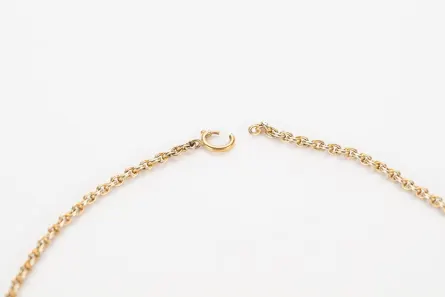
Clasps are rarely seen, but they decide whether the look survives the day. A spring ring too light for the chain can open with movement. A lobster with a thin gate can wear loose. Magnetic clasps are convenient but need a safety catch if the chain is valuable or carries a heavy pendant.
With fine chains, a multi-strand clasp or small clasp converter cuts the number of fastenings at the back of your neck and holds the chains at fixed spacing so they don’t twist into each other. The trade-off: the set has to be stored and worn together.
Check the joins too. A jump ring should be closed flush, ideally soldered on a chain carrying weight. If two chains keep tangling, look at link shape and finish; rough edges and broad flat links create friction, smooth rounded links slide past each other.
Ear stacks need balance
The same idea works at the ear, but anatomy is less forgiving. Multiple piercings can carry a stack if the weight is spread. A larger piece on the lobe and smaller ones higher up usually stays more comfortable than putting the heaviest earring through thin cartilage.
A modern ear stack often has one strong shape, a chunky hoop or substantial stud, then two lighter details above. Matching metals aren’t required, but repeating one form keeps it looking intentional. Every piece a different shape, size and finish starts to look busy.
Backs matter as much as fronts. A wider disc or secure lever back spreads pressure across the lobe; a thin post carrying a heavy earring concentrates load and can slowly stretch the piercing. For an all-day stack, choose the closure with the most definite action, not just the smallest.
Ring stacks and hand proportions
Treat a ring stack as one object. Two 2 mm bands together behave like a 4 mm band, and three fine rings can feel tight even when each fits alone. Wide bands generally need a slightly larger size, so size the stack together and leave room for fingers to swell during the day. For reference, a US size 7 has an inside diameter of about 17.3 mm; half a size is under half a millimeter of diameter, which is why stacks feel tight so quickly.
Hand proportions matter more than rules. Short fingers can carry several fine bands, but wide bands and big stones crowd them fast. Longer hands support a broader signet or a taller stack. The strongest arrangement usually has one wider or more detailed ring and one or two quieter companions.
Wear should stay even. A stack that pinches on one side, spins constantly or leaves a deep mark is too tight, however good it looks. Bands worn together for years also abrade each other. A little movement beats constant pressure, and a thin spacer can protect a softer stone from a harder neighbor.
Keep the palette controlled
Warm yellow gold is still the natural center of most stacks, but it needn’t be alone. A single white gold or silver-toned chain sharpens the group; a rose gold detail warms it. Each metal should have a reason to be there.
Pearls and stones can join when scale is considered. Small pearls between gold links add texture without competing with a pendant. One colored stone can be the focal point, with clear stones or plain polish supporting it. If a ring sits against other bands, choose a setting that protects the stone’s edges.
Layering routine
Before buying another chain or ring, build the stack from what you own, on your body:
- Fasten chains and check the real distance between layers.
- Remove anything that repeats the same length, scale and texture without improving the group.
- Pick one focal point; keep the rest quiet.
- Check every clasp suits the weight it carries.
- Try a ring stack as a set, not separate rings.
- Put the heaviest earring in the strongest piercing and balance the rest around it.
- Store layered chains separately or on a clasp converter to keep them spaced.
The best layered gold looks collected, not bought all at once. Start with one strong piece, add a second only when it creates real contrast, and let the clasps, links and settings decide whether the stack earns a place in daily rotation.