Why the Brooch Is Back (and Where to Pin It)
- Trinket File
- Styling
- 21 Oct, 2026
Pin it higher than you think.
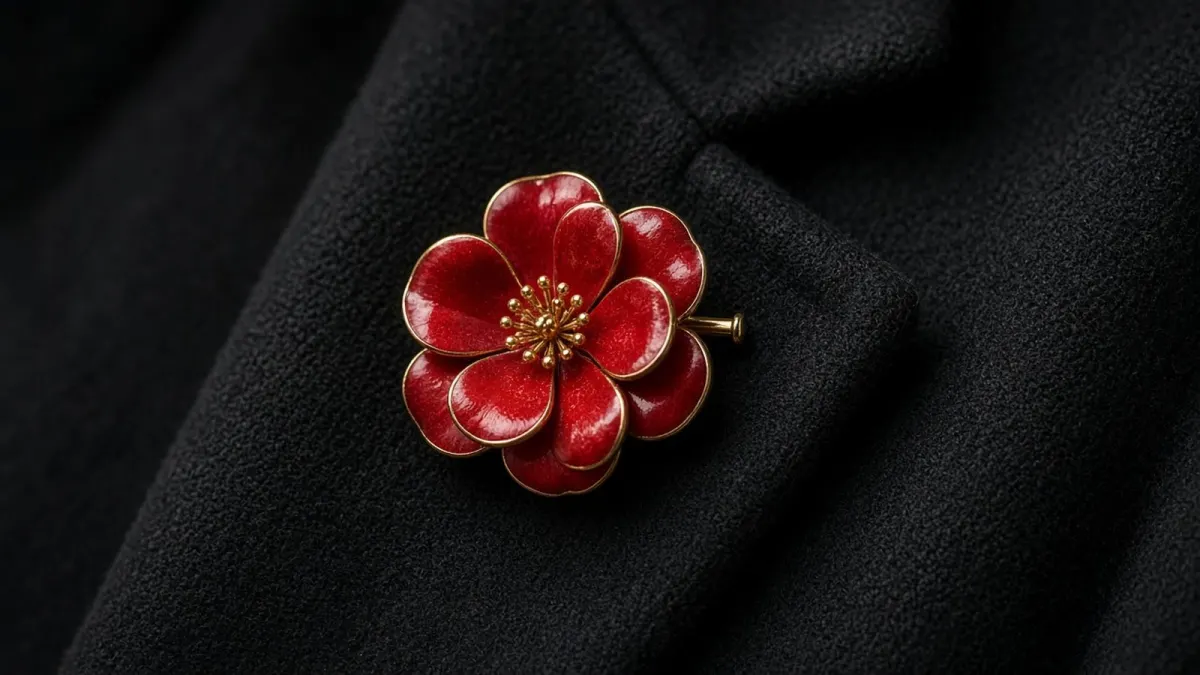
That’s most of the advice, honestly, but the brooch has been out of rotation long enough that a lot of people have forgotten how to wear one. It’s worth relearning this autumn. Harper’s Bazaar’s 20 October trend report named red “a new neutral” for autumn 2026 and noted brooches, belts and jewellery appearing in crimson, with Chanel, Tory Burch, Khaite and Celine among the houses showing pops of red. The magazine’s own starting suggestion was a brooch on your favourite black jacket for the office.
Vogue’s roundup of the season’s trends points the same way with gloves, velvet and fringe in an Art Deco evening story. Small, deliberate accessories are doing a lot of work right now.
So. Where does it go?
On a jacket lapel
The classic spot, and still the best one for a first brooch.
Place it on the left lapel, roughly level with where a buttonhole would sit, a little below the collarbone. Angle it slightly so the top of the design points towards your shoulder rather than straight up. That angle follows the line of the lapel, and it’s why a brooch on a jacket tends to look intentional instead of stuck on.
If your jacket has a real lapel buttonhole, you can pin through the fabric just beside it. Don’t push the pin through the buttonhole itself unless the brooch has a stem fitting made for it; a standard pin and catch will slide out.
Harper’s example was Khaite’s floral brooch, listed at US$440 on khaite.com in that story (October 2026). You don’t need that one. A vintage red enamel or red glass brooch on a black jacket gets you to the same place, and second-hand is where brooches have been hiding for years.
On a coat
Coats are where you can go bigger. A heavy wool coat carries weight that would drag on a silk blouse.
Try it high on the collar, near the throat, if the collar stands up. Or at the shoulder, about where a shoulder seam meets the front panel. On a double-breasted coat, a brooch on the upper button line, between the top two buttons, gives it a slightly military look that sits well with this season’s tailoring.
Check the coat’s weave first. A smooth, dense wool takes a pin cleanly. A loose bouclé or a mohair blend can catch on the clasp when you take it off.
On knitwear, carefully
This is the one people get wrong, and the result is a pulled thread in a jumper you loved.
A heavy brooch on a fine knit is a bad pairing. The pin goes through between stitches, the weight drags the knit down, and every time you move the brooch sways and works at the yarn. Fine merino and cashmere are the worst for it. You’ll see the stitches stretched in a little V below the pin by the end of the day.
Three fixes, in order of how much I’d trust them:
- Pin through a seam. Shoulder seams and neckline seams on a jumper are reinforced and much less likely to ladder. Placing the brooch where a seam runs is the single best habit.
- Back it with felt. Cut a small circle of felt and put it inside the garment behind the pin, so the clasp holds the felt as well as the knit. It spreads the load.
- Go lighter. A small enamel pin or a flat brooch is far kinder to a fine knit than a chunky cast piece with stones.
If you love the look of a big brooch on knitwear, save it for chunky, tightly knitted wool. It’ll hold.
On a belt, a bag or a scarf
Harper’s also mentioned belts in crimson, and the red-belt idea, with raw jeans and a white T-shirt, works with a brooch too. Pin a small brooch at the centre front of a plain leather belt, just to one side of the buckle. It’s unusual and it’s easy.
On a bag, pin through a strap rather than the body, so you’re not putting holes in the main panel of the leather.
On a silk scarf, a brooch can replace a knot. Gather the scarf at the side of the neck and pin through all the layers. Use a brooch with a safety catch here; silk is slippery and a basic C-clasp can open.
Checking the fittings
Before you wear a second-hand brooch, look at the back. The pin should be straight and sharp enough to pass through fabric without forcing. The catch should close firmly, ideally with a rotating safety lock. A pin that’s bent or a catch that swings open on its own needs fixing before the brooch goes on a coat you’re walking down the street in.
Most jewellers can replace a pin stem or a catch, and on older pieces it’s often worth doing. Our guide to resizing and repairing jewellery covers which repairs are simple. And if you’re buying vintage, read buying second-hand jewellery for what to check on plating and stones.
My view: one red brooch, worn on a black jacket three days a week, will do more for an autumn wardrobe than a new necklace. It’s the cheapest way into the season’s colour, and it’s the most noticeable.